What Picasso Can Teach Us About AI
“It took me four years to paint like Raphael, but a lifetime to paint like a child.”
— Pablo Picasso
During a presentation I gave at work about AI-assisted coding, someone asked: “What about the skills we’ve already learned? Are they useless now? What should we do?”. I answered with a story about Picasso.
The Craft#
In 1896, a fourteen-year-old Pablo Picasso painted First Communion. It was his first large-scale oil painting, created for a major exhibition in Barcelona. His father posed as the father figure in the scene. His sister Lola knelt as the young communicant in white. The painting radiates with warm reds against the brilliant white of her communion dress, candlelight illuminating every fold of fabric, every texture on the altar cloth rendered with patient precision.
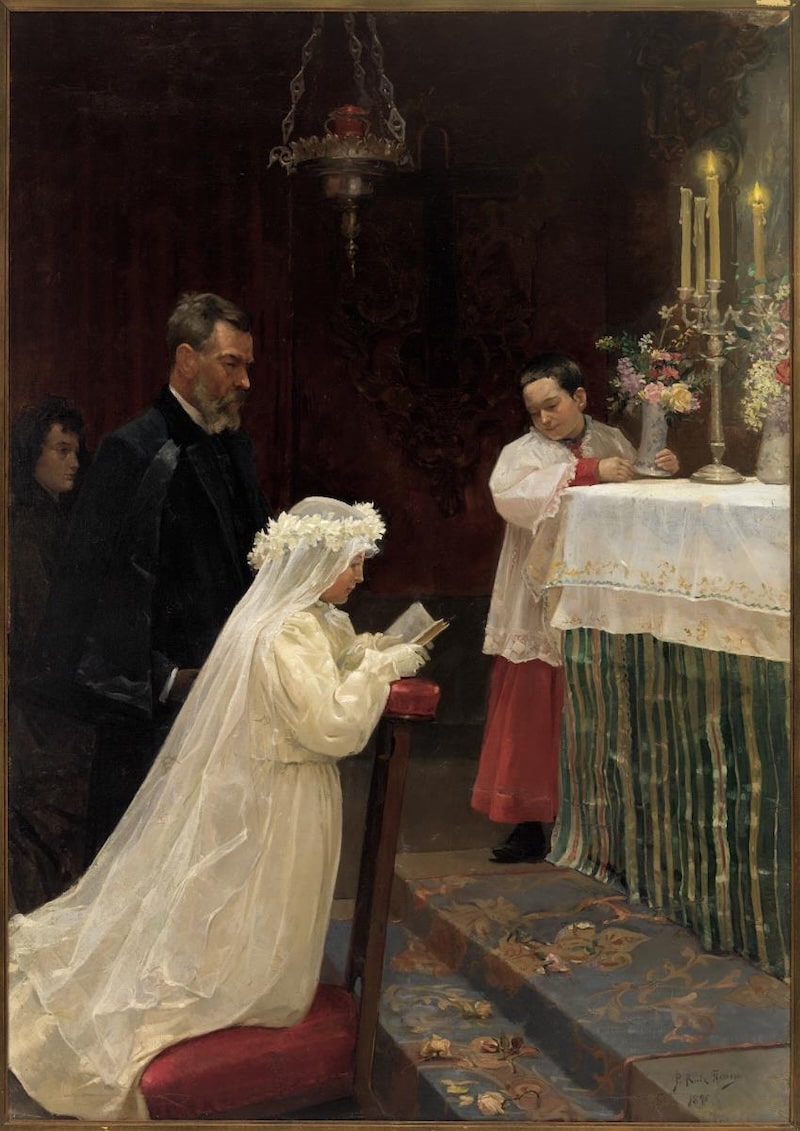
First Communion, 1896 by Pablo Picasso
No one looks at this painting and thinks “modern art.” They think: this kid can paint.
Picasso had been receiving formal training since age seven. By thirteen, his father (himself a painter and art professor) reportedly felt that his son had surpassed him. The young Picasso could draw anatomy, render light, compose scenes with the confidence of someone three times his age. His craft was beyond question.
The Bull#
In December 1945, nearly fifty years later, Picasso walked into Fernand Mourlot’s lithography workshop in Paris and began working on a series of prints depicting a bull. Here’s the final eleventh result:
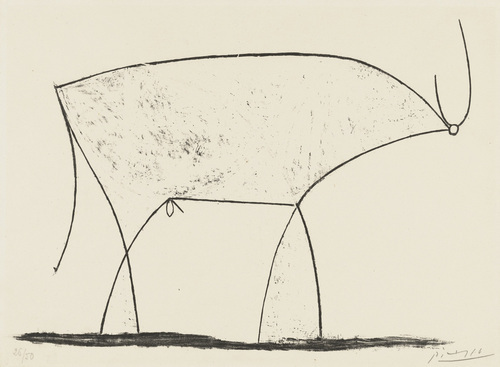
Bull (plate XI), 1946 by Pablo Picasso
The first lithograph was a magnificent, fully rendered animal: muscular, weighty, alive. A superb bull. The printers in the workshop admired it. That was that, they thought.
But Picasso kept going. He produced a second version, then a third, each time stripping away detail, simplifying the form, removing what he decided was unnecessary. The printers watched, puzzled. The bull lost its shading, then its mass, then its volume. By the middle of the series it looked like a Picasso. By the end, after eleven lithographs reworked on the same stone over the course of a month, the bull had become a handful of lines. Maybe twelve strokes in total. A child’s doodle, or so it appeared.
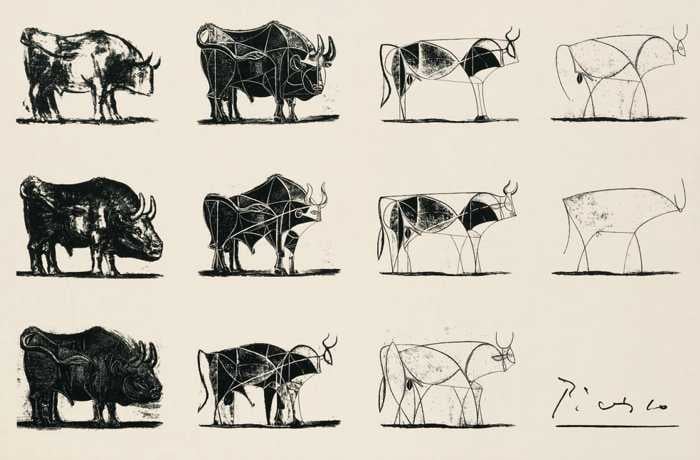
Bull Lithographs, 1946 by Pablo Picasso
Mourlot’s assistant, Jean Célestin, looked at the final print and said that Picasso had ended up where he really should have started. But Mourlot himself saw something different. He had watched the entire process, the reducing, always reducing, and he knew that behind those few lines lay an enormous amount of invisible work.
That final bull is still, unmistakably, a bull. Every line is load-bearing. Nothing is decorative. Nothing is there because the artist’s hand was merely filling space. The simplicity is not the absence of skill. It is the product of skill, compressed until only the essential remains.
Apple reportedly uses this exact series in its internal design training. The lesson: true simplicity isn’t where you start. It’s where you arrive, after you’ve understood a thing so deeply that you know what can be removed.
The Prompt#
Anyone can type a few words into Nano Banana and produce a stunning image in seconds. Photorealistic portraits, surreal landscapes, product shots that look commercial-grade. Someone with no artistic training can generate images that would have taken years of study and practice not long ago. This isn’t some hypothetical future; it’s already ordinary.
The same thing is happening in software engineering, in writing, in legal research. The craft layer, the part that used to take years to master, is being compressed into a prompt. The output looks polished. To an untrained eye, it looks indistinguishable from the work of an expert, just as Picasso’s final bull looks like something anyone could draw.
But here’s the question that matters: could anyone have arrived at those specific lines? Could someone who had never drawn a realistic bull, who had never understood muscle and bone and weight, have known which lines to keep and which to discard? Could they have even recognized the final version as better than the third or the seventh?
That kind of judgment, knowing what matters and what doesn’t, is what Picasso spent a lifetime building. It’s the conceptual layer that sits above the craft. And it’s the thing that AI has not replaced.
What Stays, What Shifts#
There have always been two layers to any skilled work.
The first is the conceptual layer: your ideas, your judgment, your taste, and what I’d call your meta-craft. Meta-craft is the intuition about what will work before you try it, the feel for when something is wrong before you can explain why. Picasso in his late period wasn’t grinding his own pigments or stretching his own canvases. But he had strong opinions about materials and light and what a canvas could hold. He had internalized the craft so completely that it became instinct. That’s meta-craft. It sits in this upper layer, alongside your ideas and your vision.
The second is the craft layer: the hands-on execution. The brushstrokes, the rendering, the technical skill that turns a concept into a finished work.
This structure is not new. It has been around for as long as humans have made things. A Renaissance master had vision and judgment (first layer) and the manual skill to paint a fresco (second layer). An architect has spatial thinking and structural intuition (first layer) and the drafting ability to produce plans (second layer). A software engineer has design sense and debugging instinct (first layer) and the coding fluency to ship it (second layer). What’s happening now is not a new structure; it’s a shift in where the boundary falls.
AI is compressing the craft layer. Execution that used to require years of manual skill can now be produced by a well-directed prompt. But the conceptual layer, the ideas, the judgment, the meta-craft, stays human. What remains of the craft layer for humans is harnessing: directing AI tools well, knowing their strengths, catching their failures, iterating toward the result you can see in your head but can’t yet point to on screen.
Harnessing is the new craft, and it matters. But it shifts with each generation of tools, just as brushwork techniques shifted with each generation of paint.
Standing on a Sand Dune#
My wife made an observation and pointed out that everyone adopting AI right now is an early adopter. We’re still on the cusp of this revolution, not in the middle of it. There will be swift changes and a lot of instability coming, but being early gives us a better chance at catching up and adapting as the landscape shifts.
The older generation with more experience might produce better output with AI right now, because we have the meta-craft to direct the tools. But younger people who grew up in a fast-moving technological landscape think differently. They have YouTube, AI tutors, and an instinct for picking up new tools that older professionals simply lack. They’ll find ways to work with AI that are unthinkable for people like me, who built our instincts on more traditional, manual foundations. The advantage we have today is real, but not permanent.
We’re all standing on sand dunes. You can climb to the top of one and feel like you’ve got a commanding view, but dunes move. The wind reshapes them. The peak you’re standing on today might flatten out tomorrow while a new one rises somewhere you weren’t looking. Whatever expertise we build on today’s platforms is shaped by a wind that doesn’t stop blowing.
That’s not cause for despair; it’s actually a useful clarification. The shifting sand is not the problem. The illusion that the dune beneath you is solid ground is.
If you attach your identity to mastery of a specific tool, you will suffer every time the landscape rearranges. If you attach it to your capacity to learn, to conceptualize, to will something into existence and struggle to make it better, then each shift is not a loss but a new surface to work on.
Specific skills are always temporary. The capacity to acquire them, and the judgment to know which ones matter, is what compounds.
A Lifetime of Painting Like a Child#
Picasso didn’t arrive at the final bull and stop. He didn’t find one style and settle in. His career was a series of reinventions: realism, the Blue Period, the Rose Period, African influences, Cubism, Neoclassicism, Surrealism, and decades of late work that baffled critics who had just gotten comfortable with whatever came before.
Each transition looked like regression to those who loved the previous phase. Each required letting go of mastery he had already earned. The Cubist Picasso had to unlearn the realist Picasso. The late Picasso had to unlearn them all.
This is what the Raphael quote actually means. It’s not a boast about precocious talent; it’s a confession about how hard it is to shed accumulated technique and see clearly again. To paint like a child is to see without the filters of expertise, without the comfortable patterns, without assuming that yesterday’s mastery is good enough for today’s canvas.
So what do we do with the skills we’ve already learned? Are they useless?
No. They are the first bull. They are what built your meta-craft: the instinct for when something is off before you can articulate why. Without that, you can’t tell what’s essential from what’s excess. Without that, you’re not Picasso drawing a bull in twelve lines. You’re just someone who can’t draw a bull.
But those skills alone are not enough. They were never meant to be the destination; they were the passage.
The people who will do well in this era are not the ones who cling to the craft they’ve already mastered. They are the ones willing to spend a lifetime learning to paint like a child: to keep seeing with fresh eyes, to keep letting go of what worked yesterday, to keep struggling toward clarity even when the medium changes under their hands.
That willingness is the one thing AI cannot replace. It isn’t a skill; it’s a posture toward a world that never sits still.